

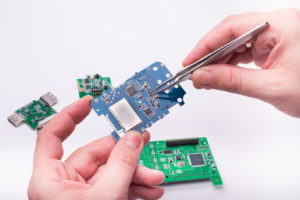
Printed circuit boards (PCBs) are essential components in nearly every modern electronic device, from consumer electronics and medical equipment to industrial automation, telecommunications, and automotive systems. However, the terms PCB manufacturing and PCB assembly are often used interchangeably, even though they describe two different stages of electronics production.
Understanding the differences between these processes can help businesses make better decisions when selecting an electronics manufacturing partner.
At Yun Industrial / ACME PCB Assembly, we provide comprehensive PCB manufacturing coordination and assembly services, helping customers streamline production, maintain quality, and bring electronic products to market efficiently.
What Is PCB Manufacturing?
PCB manufacturing, also known as PCB fabrication, is the process of producing the bare printed circuit board that provides the foundation for an electronic assembly.
The board contains copper traces, pads, and other conductive features that create electrical connections between components. Depending on the design, a PCB may consist of a single layer, two layers, or multiple layers of conductive and insulating materials.
The PCB manufacturing process generally includes:
- PCB Design Review: Reviewing the layout, Gerber files, drill files, and other manufacturing specifications.
- Material Preparation: Selecting suitable substrate materials, such as FR-4, and preparing copper-clad laminates.
- Copper Patterning: Creating conductive traces and circuit patterns through imaging and etching processes.
- Drilling and Plating: Creating holes and vias that connect different layers of the circuit board.
- Layer Lamination: Bonding multiple layers together when manufacturing multilayer PCBs.
- Solder Mask Application: Applying protective coatings that help prevent unintended solder connections.
- Silkscreen Printing: Adding component labels, reference designators, and other identifying information.
- Inspection and Electrical Testing: Verifying that the completed bare board meets applicable design and manufacturing requirements.
The result is a bare printed circuit board ready for electronic component installation.
What Is PCB Assembly?
PCB assembly, commonly called PCBA, is the next stage of electronics manufacturing. During this process, electronic components are placed and soldered onto the fabricated printed circuit board.
These components may include resistors, capacitors, transistors, integrated circuits, diodes, connectors, and other devices required for the product to function.
There are three primary PCB assembly approaches.
Surface Mount Technology (SMT)
Surface Mount Technology involves placing electronic components directly onto pads on the PCB surface. Automated placement equipment and reflow soldering are commonly used to create accurate, consistent connections.
SMT is widely used in modern electronics because it supports compact designs, high component density, and efficient production.
Through-Hole Technology (THT)
Through-hole assembly involves inserting component leads through drilled holes in the printed circuit board and soldering them into place.
This method is frequently used for connectors, larger components, and applications where additional mechanical strength may be beneficial.
Mixed-Technology PCB Assembly
Many electronic products require a combination of SMT and through-hole components.
Mixed-technology assembly allows manufacturers to use both approaches on the same printed circuit board, providing flexibility for products with diverse electrical and mechanical requirements.
PCB Manufacturing vs. PCB Assembly: Key Differences
Although both processes are essential, they serve different purposes.
| PCB Manufacturing | PCB Assembly |
|---|---|
| Produces the bare circuit board | Installs electronic components |
| Creates copper traces and electrical pathways | Creates soldered component connections |
| Uses drilling, etching, plating, and lamination | Uses placement and soldering equipment |
| Focuses on board construction and fabrication quality | Focuses on component placement, soldering, and assembly quality |
| Produces a bare PCB | Produces an assembled PCBA |
A properly fabricated PCB is essential for successful assembly, while accurate component placement and soldering are necessary for the finished electronic product to operate as designed.
Why Choose a Turnkey PCB Manufacturing and Assembly Partner?
Working with separate companies for PCB fabrication, component sourcing, assembly, and testing can increase costs and complicate production schedules.
A turnkey PCB assembly provider simplifies the process by coordinating these manufacturing stages through a single point of contact.
Benefits of turnkey electronics manufacturing include reduced vendor management, improved communication, more efficient component sourcing, coordinated production schedules, and consistent quality oversight.
For companies developing new products, this approach can be especially valuable when moving from prototype PCB assembly into larger production quantities.
Quality Control in PCB Manufacturing and Assembly
Quality control is essential throughout the electronics manufacturing process.
Bare printed circuit boards are evaluated using applicable industry standards, including IPC-A-600, which addresses the acceptability of printed boards.
Completed PCB assemblies are evaluated using applicable assembly standards, including IPC-A-610, which establishes acceptability criteria for electronic assemblies.
Inspection methods may include visual inspection, Automated Optical Inspection (AOI), electrical testing, and functional testing, depending on the project’s specifications.
These procedures help identify manufacturing defects, improve consistency, and reduce the possibility of problems during final product operation.
ACME PCB Assembly: Your Electronics Manufacturing Partner
Yun Industrial / ACME PCB Assembly understands that successful electronics manufacturing requires careful coordination between PCB fabrication, component procurement, assembly, inspection, and delivery.
Our experienced team works with customers to understand their technical requirements, production quantities, and scheduling needs.
Whether you need prototype PCB assembly, SMT assembly, through-hole assembly, or complete turnkey manufacturing services, we provide solutions designed to support your project from development through production.
By combining manufacturing experience with responsive customer service and a commitment to quality, ACME PCB Assembly helps businesses simplify electronics production while maintaining competitive pricing and dependable turnaround times.
Contact ACME PCB Assembly Today
Choosing the right PCB manufacturing and assembly partner can make a significant difference in the success of your electronic product.
At Yun Industrial / ACME PCB Assembly, our goal is to provide dependable manufacturing solutions that help customers reduce complexity, improve efficiency, and maintain consistent product quality.
Contact our team today to discuss your next PCB project and learn how our complete electronics manufacturing services can help bring your design to life.
Frequently Asked Questions
What is the difference between PCB manufacturing and PCB assembly?
PCB manufacturing produces the bare printed circuit board, including its copper traces, layers, holes, and protective coatings. PCB assembly involves installing and soldering electronic components onto that board to create a functional electronic assembly.
Can one company handle both PCB manufacturing and PCB assembly?
Yes. A turnkey PCB assembly provider can coordinate PCB fabrication, electronic component sourcing, assembly, inspection, and testing. This reduces the need to manage multiple vendors and helps streamline the manufacturing process.
What is the difference between SMT and through-hole PCB assembly?
SMT places components directly onto the surface of a printed circuit board, while through-hole assembly inserts component leads through drilled holes. Both methods remain important in electronics manufacturing, and many products use a combination of the two.
Why is quality control important in PCB manufacturing?
Quality control helps identify fabrication defects, incorrect component placement, soldering problems, and other issues that could affect the performance or reliability of an electronic product. Inspection and testing are important at both the bare-board and assembly stages.
Contact us today to learn more.